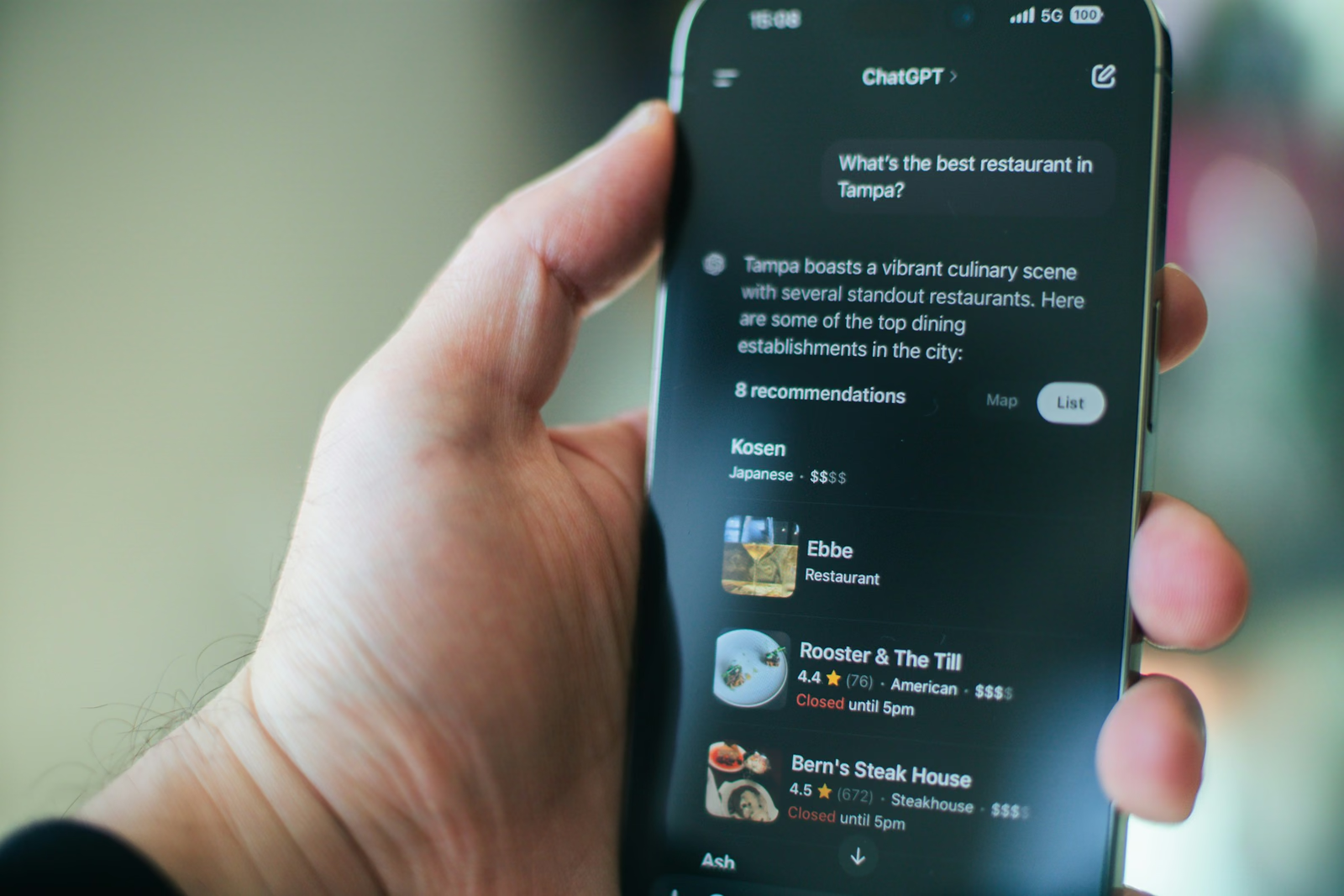
More people now ask ChatGPT or Google’s AI to recommend a local business, instead of scrolling through search results. The AI gives them two to four names. This guide explains why your business might not be one of them, and the simple changes to your website and Google profile that help you get recommended.
Why this matters for local businesses
Imagine a homeowner in Enfield with a tap that won’t stop running at 9pm. A year ago they’d have searched “emergency plumber Enfield” on Google and called whoever was top of the map. Now there’s a good chance they open ChatGPT or Google’s AI Mode and ask: “Who’s a reliable emergency plumber near me that’s open now?”
They get three names and a short paragraph about each. Would one of them be you?
For most small businesses, the honest answer is no. The AI doesn’t think they’re bad. It just doesn’t know enough about them. The good news is you can fix that without buying anything.
How many people use AI to find a business
In February, BrightLocal’s consumer survey asked people where they go for local business recommendations. 45% said ChatGPT or a similar AI tool. A year earlier it was 6%. That’s a US survey, but the UK is heading the same way. Ofcom says ChatGPT had 1.8 billion UK visits in the first eight months of 2025, up from 368 million in the same period of 2024.
Google is using AI too. Its AI Overviews and AI Mode are both live in the UK, and Ofcom reports that about 30% of UK searches now show an AI Overview. Even if you never use ChatGPT, your customers are seeing AI answers.
How AI tools choose which businesses to recommend
AI tools don’t have their own opinion about your business. They build a shortlist from a small number of sources and write a summary around it.
In September 2026, BrightLocal looked at nearly two million sources quoted by ChatGPT, Google AI Mode and AI Overviews across 200,000 local searches. Two kinds of source came out on top:
- Business websites made up 42% of everything the AI quoted.
- Google Business Profiles made up another 28.5%.
That’s over 70% from two places, and you control both of them. Yelp came a distant third at under 10%. The rest came from a mix of directories and social media.
The study also found that Google Maps showed a business it tracked 66% of the time, but the AI tools mentioned it only 32% to 38% of the time. AI answers are also shorter. ChatGPT named four businesses on average, and Google’s AI Overviews named two or three. With fewer names to give, the AI picks the businesses it understands best.
What the AI needs to know about you
An AI tool can’t ring you to check. It can only use what’s written online. So if it read your website and Google profile, could it answer these questions without guessing?
- What exactly do you do? Not “property services”, but “boiler repairs, bathroom fitting and landlord gas safety checks”.
- Where do you work? Named towns and areas, not “the South East”.
- When are you available? Real opening hours, plus emergency hours if you offer them.
- Roughly what do you charge? Even “callouts from £85” helps.
- Are you any good? Recent reviews that mention the work you did.
- How can someone contact you now? Phone, WhatsApp, or a form that works.
Most small business websites can’t answer half of these. They say “quality service at competitive prices” when the AI needs “emergency plumber, Enfield and Barnet, 7 days a week, callouts from £85”.
Five things to do this week
1. Fill in every part of your Google Business Profile
Every section, not just most of them. Your main category, extra categories, services with clear names, opening hours (including bank holidays), a description in plain words, your website link, and at least ten photos of your work. Google’s own help pages say complete, accurate profiles are more likely to show up in local results, and your profile is one of the two main places AI tools read from.
2. Give each service its own page and answer common questions on it
Semrush looked at the pages ChatGPT quotes, and almost 90% of the time they ranked 21st or lower on Google. So you don’t need to be top of Google for the AI to use your page. You need a page that answers the question properly. AI tools quote pages like “Emergency plumber in Enfield” that say what you fix, when you can come out and what it costs, with a few recent reviews underneath.
Add short questions and answers to those pages. For example: “Do you come out at weekends?”, “How quickly can you get to Palmers Green?” and “Do you charge a callout fee?” These are the questions people ask AI tools, so they’re what the AI looks for.
3. Keep your details the same everywhere
Use the same business name, phone number and address on your website, Google profile, Facebook and any directories. If the AI finds “J Smith Plumbing” in one place and “Smith’s Plumbing & Heating Ltd” in another, it may think you’re two different businesses and recommend neither.
4. Get recent reviews that mention the job
A review that says “great service” tells the AI very little. A review that says “came out to Winchmore Hill at 9pm, fixed the burst pipe under the sink, charged what he quoted” tells it a lot. You can’t write the review, but you can ask: “Would you mind saying what we fixed and where you are?”
5. Test it yourself
Ask ChatGPT and Google’s AI Mode the questions your customers would ask. For example: “Best nursery near Ipswich with forest school sessions”, “Accountant in Harrogate for a sole trader on Making Tax Digital” or “Personal trainer in Sutton who does early morning sessions”. See who comes up, then look at their website and Google profile. You’ll usually see why they were picked. Try again in a month.
What not to do
- Don’t fill your pages with “best plumber” fifty times.
- Don’t pay for a tool that promises to “rank you in ChatGPT”.
- Don’t rewrite your website as stiff question-and-answer blocks that nobody would enjoy reading.
AI tools are trying to find businesses that real people would recommend. The more your website reads like a friendly expert explaining what you do, the better it works for both people and AI.
And don’t worry too much about losing website visits. Pew Research found (in the US) that people click a normal search result 8% of the time when an AI summary appears, compared with 15% when it doesn’t. That matters for bloggers, but much less for a local business. Someone with a burst pipe isn’t reading articles. They want a name and a number to call. Your aim is to be one of the names in the answer.
Most of your competitors haven’t done this yet
Many local businesses still have a website that says “Welcome to our website” and a Google profile they haven’t touched since 2021. AI tools read from a short list of sources, and the two that matter most are things you can fix this week.
If your website can’t be fixed, because it’s old or you can’t log in to it any more, start there. A pay monthly website from Ubie comes with a page for each service, and our local SEO service can take care of your Google profile if you’d rather not. But start with the checklist above. It only costs you an afternoon.