
Recruitment Website Design
Websites for recruitment agencies that bring in candidates and clients. Designed by Ben from £39 a month, with hosting, email, updates and support in the price.
 Rated 4.7 out of 5 on Trustpilot and Google · 40 reviews
From £39a month
No setup fee · yours after 12 months
- Separate routes for job seekers and employers
- Domain, hosting, email and SSL included
- Most websites live in under 2 weeks
- UK support from the person who built it
Packages start with 12 months, then carry on month to month at the same price. Cancel with 30 days’ notice.
One website, two kinds of visitor
A recruitment website has to speak to two groups at once. Job seekers want to find a role and apply in a few taps. Employers want to know you understand their sector and can fill a gap fast.
When a website mixes the two up, both groups leave. So before any design work, Ben packages the route each visitor takes, from the homepage to the form that matters to them.
1Four1 Recruitment shows how this works. From the homepage, job seekers go straight to health care, industrial or driving jobs. Employers get their own section on how the agency helps them hire.

1Four1 Recruitment, a family-owned job agency covering Sussex and Surrey.
What makes a recruitment website work
Recruitment sites succeed or fail on a handful of things. These are the ones we plan in from day one.
Jobs that are easy to find
Each vacancy gets its own page with the pay, place, hours and what the role involves. Group them by sector so people can browse.
A quick way to apply
A short form with name, email, phone and a CV upload. Every extra box loses applicants, most of all on a phone.
A form for employers
A simple way for a business to tell you about a role, or ask for a call, without picking up the phone first.
A page for each sector
Care, driving, warehouse or office work. Each sector page talks to the job seekers and the employers in it.
The towns you cover
Most people look for work near home, such as “warehouse jobs Crawley”. Area pages help you show up for those searches.
Built for phones
Most job hunting happens on a phone, often on a break or on the bus. Pages have to load fast and forms have to be easy to fill in.
Care with personal data
CVs hold home addresses and work history. Forms should ask only for what you need and link to your privacy notice.
Proof on both sides
Reviews from candidates and from client companies, plus the kinds of roles you fill, build trust with both groups.
Advice worth coming back for
Short posts on interview tips, CVs or local pay give job seekers a reason to return, and give Google more to find.
The job seeker’s route and the employer’s route
Here is what each visitor should be able to do on a well planned recruitment website.
Job seekers
- Pick their type of work from the homepage in one tap
- See current jobs with pay and location up front
- Apply from a phone in about a minute, CV attached
- Get a clear message saying what happens next
Employers
- See the sectors and areas you cover straight away
- Read how you find, check and place staff
- Send a vacancy or ask for a call through a short form
- Read reviews from businesses like theirs
Ben maps out both routes before he designs a single page, so each visitor sees what matters to them first.
Showing your vacancies: three ways to do it
This is the question most agencies ask first, so here is a straight answer. There are three common ways to show jobs on your website.
Job pages on your own website
Each role gets its own page and an apply form with a CV upload. This is how the jobs section on the 1Four1 Recruitment website works. It suits agencies that post a handful of roles a week. Ask Ben if you would like it set up.
A feed from your recruitment software
Some agencies post jobs in software such as Bullhorn, Vincere or JobAdder and want them to show on the website by themselves. Whether that works depends on your software, so Ben checks it with you before promising anything.
Links to the big job boards
If you already advertise on Indeed, Reed or Totaljobs, your website can point to those adverts. It is quick to set up, but people then apply on someone else’s website.
Not sure which suits you? Tell Ben how many roles you post and where, and he will give you his honest view on a free call.
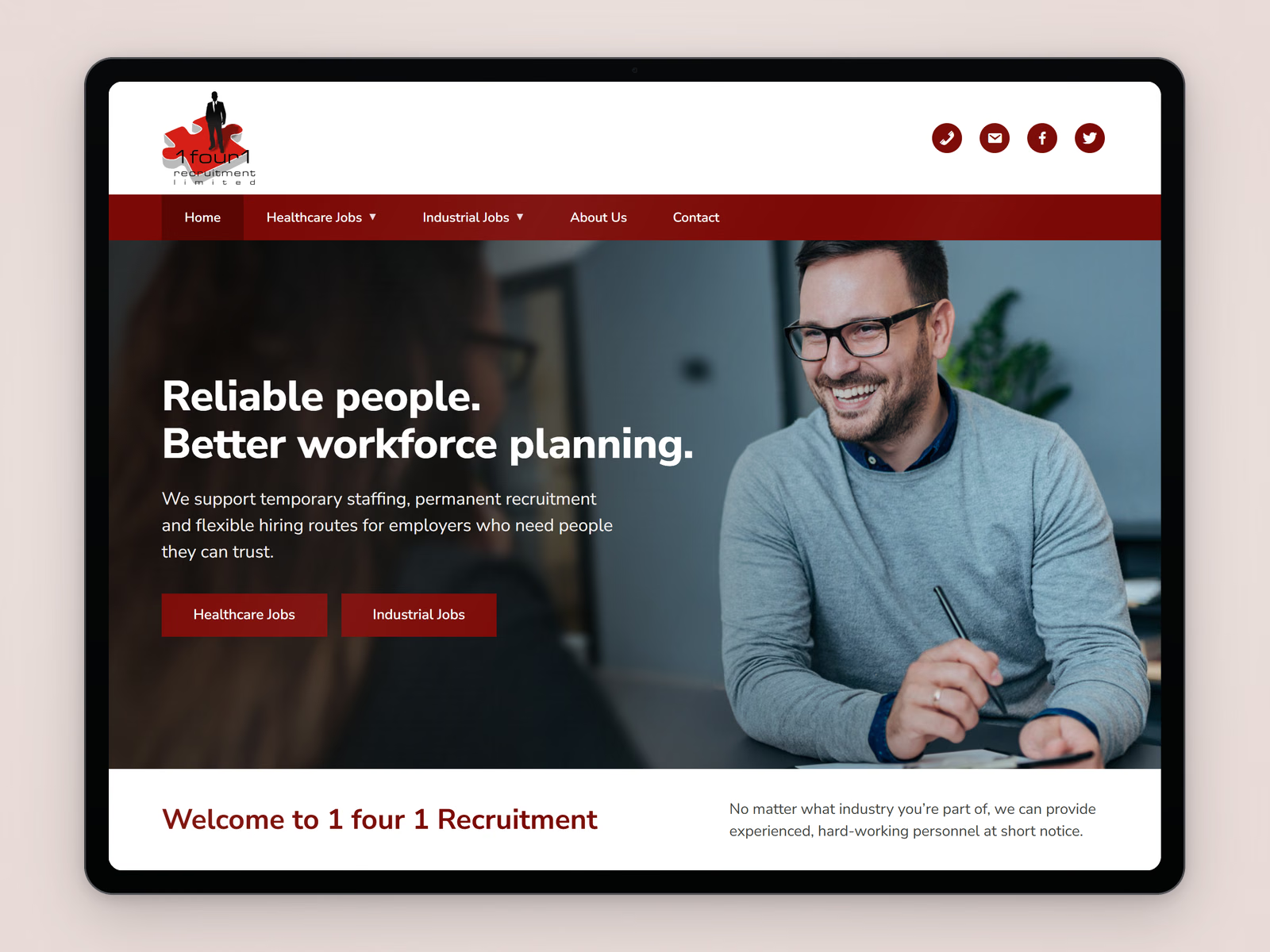
Inside the 1Four1 Recruitment website
1Four1 Recruitment is a family-owned job agency in Sussex and Surrey. It finds temporary and permanent staff for care, industrial and driving roles. Here is what its website does.
- Job seekers pick health care, industrial or driving work straight from the homepage
- Each vacancy has its own page, with a quick apply form and a CV upload
- Employers get their own section on how the agency helps them hire
- The towns it covers, from Crawley to Haywards Heath, are named on the homepage
- Answers to common questions and short posts on local jobs
Want job pages and a CV upload like these? Ask Ben on your free call and he will talk you through the options.
Getting found by job seekers and employers
Hardly anyone searches for an agency by name. They search for the job and the place, such as “care assistant jobs Horsham”, or for the service, such as “temp staff agency Crawley”.
Sector and area pages
Business includes 5 town pages and Premium includes 15. Paired with your sector pages, they help you show up in local job and staffing searches.
Google reviews on your website
On Business and Premium, your Google reviews show on the website and update on their own. You need a Google Business Profile.
Set up for search from day one
SEO tools, Google Analytics and Search Console are set up for you, with titles, descriptions and schema on every page.
Want more help with rankings? Our Local SEO packages work on your Google Business Profile, listings and rankings each month.
CVs, candidate data and GDPR
A recruitment website collects more personal data than most. A CV can include a home address, work history and sometimes health details. A few simple habits help you handle it properly.
Ask only for what you need
Name, email, phone and a CV are enough to start. Leave out date of birth and anything you would not ask at interview.
Say what happens to the data
Link to your privacy notice from every form. Say who will see a CV and how long you keep it.
Keep the website secure
Every package includes an SSL certificate, so forms send data over https. Daily backups and security software protect the website itself.
This is general guidance, not legal advice. The ICO website has free guides for small businesses if you want to check the detail.
Recruitment website design prices
Three packages, each with one monthly price. None has a setup fee, and the website is yours after 12 months.
Updates cover everyday changes, such as new text, photos and prices.
Compare the packages in fullWhat our clients say
“Consistently reliable service, always pro-active”

“Top tier web developers, highly recommended”

“The website has gone beyond my expectations”

From first call to first applicant
Have a short chat
Tell Ben about your agency, your sectors and how you handle jobs today. He will suggest a package, with no pressure.
Check your preview
Ben designs the website and sends you a preview. Ask for any changes before it goes live.
Go live
Most websites are live in under 2 weeks. We host it, back it up and make your changes from then on.
Questions agencies ask us
- What should an agency expect to pay for a website?
It depends on who builds it. A DIY builder costs a few pounds a month, but you do all the work. Firms that only build recruitment websites often link the site to your recruitment software, and charge more for it. Our packages cost £39, £69 or £89 a month with no setup fee, and that covers design, hosting, email, updates and support.
- What should a job application form ask for?
Keep it short: name, email, phone, the role they want and a CV upload. That is how the job pages on the 1Four1 Recruitment website work. Each extra question costs you applicants, so save the rest for your first call. Ask Ben if you would like a form like this.
- Do your websites work with Bullhorn, Vincere or JobAdder?
Sometimes. Each of these handles job feeds in its own way, so Ben will look at what yours allows before he promises anything. If a feed is not the right fit, job pages on your own website or links to your job board adverts work well.
- Do I need a page for each sector?
If you recruit for more than one kind of work, yes. A care worker and a forklift driver look for very different things. A page for each sector lets you speak to each group, and helps Google match you to the right searches. Essential includes 5 pages, Business 10 and Premium 20.
- Will my vacancies show up on Google?
Each job page is a normal web page, so Google can find it like any other. Clear job titles, the town in the text and links from your sector pages all help. Rankings depend on your area and your competition, so no honest designer can promise a position.
- Is my website GDPR compliant?
Your agency is responsible for how it handles candidate data, and the website can help. We keep forms short, use https on every page and back the website up each day. You will need a privacy notice that explains how you use and store CVs. The ICO has free guidance on this.
- How do employers send us a vacancy?
Through a short form on your employer pages. It asks for the role, the location, the company and how to get in touch, so you can call back while the need is fresh.
- Will the website work on phones?
Yes. Most job seekers look for work on their phone, so every page is built to read well and load fast on a small screen, and forms are easy to fill in with a thumb.
- How soon can my new agency website be live?
Most websites are live in under 2 weeks. It depends on how many pages you need and how quickly you send content and feedback. You see a preview first and can ask for changes.
- Do you write the words for the website?
On Business and Premium, yes. We write your pages from a short chat about your agency, your sectors and the areas you cover. On Essential, you send us the text and we lay it out. Premium also includes a blog post written for you every month.
- Which package suits a recruitment agency?
A new or one-person agency can start on Essential, with 5 pages. Most agencies with a few sectors or towns suit Business, with 10 pages and 5 town pages. Premium suits larger agencies, with 20 pages and 15 town pages.
- Can you redesign my current recruitment website?
Yes. Tell Ben what works on your current website and what does not, and he will plan the new one around that. If you already own your domain name, we transfer it.
- Who owns the website once it is built?
You do, once your first 12 months are paid. The design, content, files and database are yours. It is built on WordPress, so it is not tied to us. If you leave after that, we move the website to you or your new provider.
- Is there a setup fee or a long contract?
There is no setup fee, so your first monthly payment is all you pay to start. Packages run for 12 months, then carry on month to month at the same price. You can cancel with 30 days’ notice after that.
What a recruitment website costs
Prices range from a few pounds a month for a DIY builder to several thousand for an agency build. Here is how £39 a month compares.
DIY builder and agency figures are typical UK prices, October 2026. Your first year on Essential is 12 months at £39, which is £468.
What to have ready before we start
You do not need a brief. A short call is enough to begin, and these things make it quicker.
Your sectors
The kinds of work you recruit for, and which ones you want more of. Each main sector can have its own page.
The areas you cover
Your office and the towns you place people in. On Business and Premium these become town pages.
A few live jobs
Two or three current vacancies, so Ben can see how you advertise roles today and suggest the best way to show them.
Your reviews
A link to your Google Business Profile, or kind words from job seekers and client companies.
Your logo and colours
Send what you have. If you do not have a logo yet, we can design one as an add-on.
Your domain name
If you already own a web address, we transfer it. If not, we register one for you.
Get your agency website started
No setup fee, so your first monthly payment is all you pay upfront. Book a free 15-minute call, or sign up to a package today.
Ready to go? Sign up to the Business package for £69 a month.

Talk to Ben before you decide
I design every website myself, and you'll deal with me from your first call to launch day and after.
Book a free 15-minute call or message me on WhatsApp. I'll answer your questions and help you pick the right package, with no pressure.